
Automatic fabric filtration
for fines and sludge.
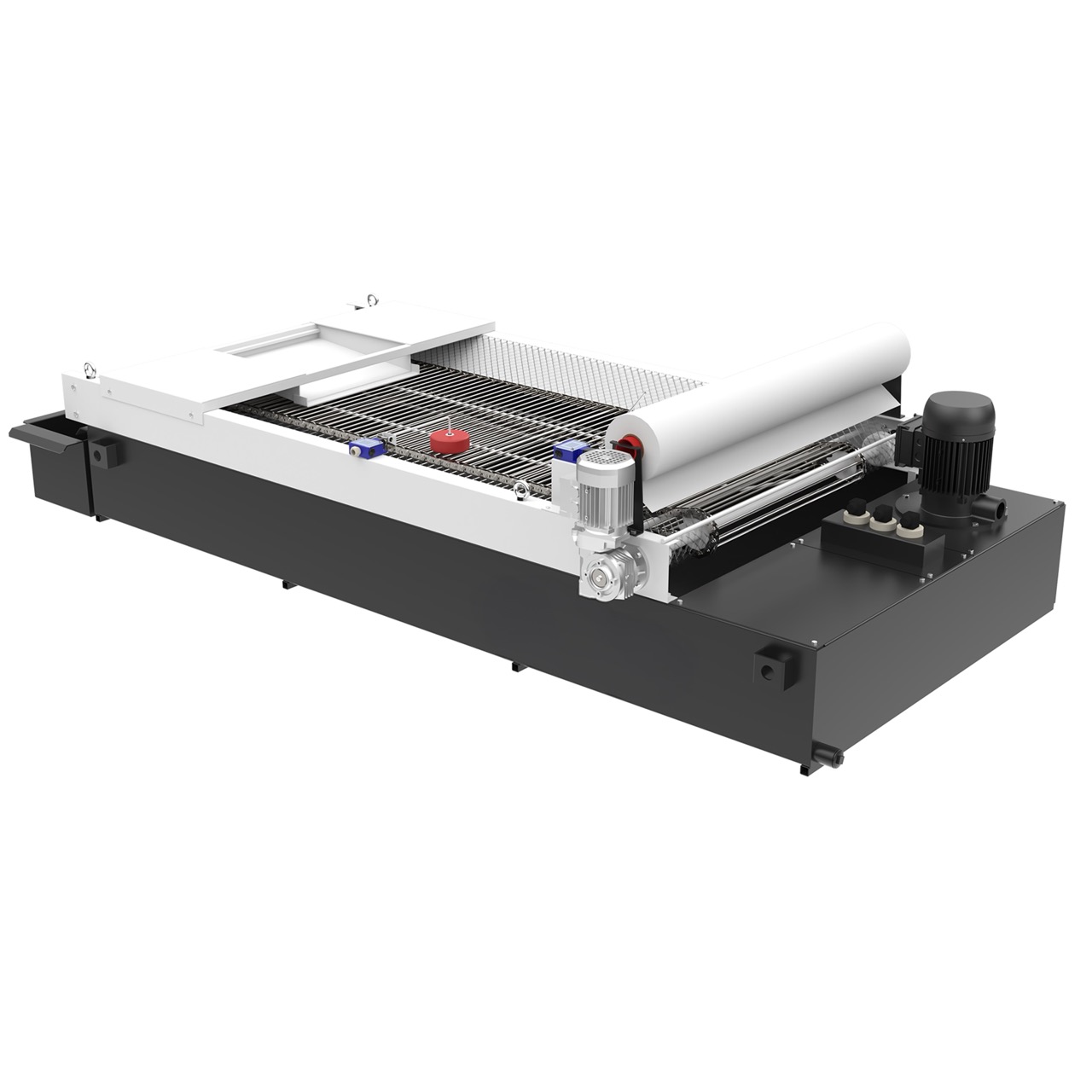
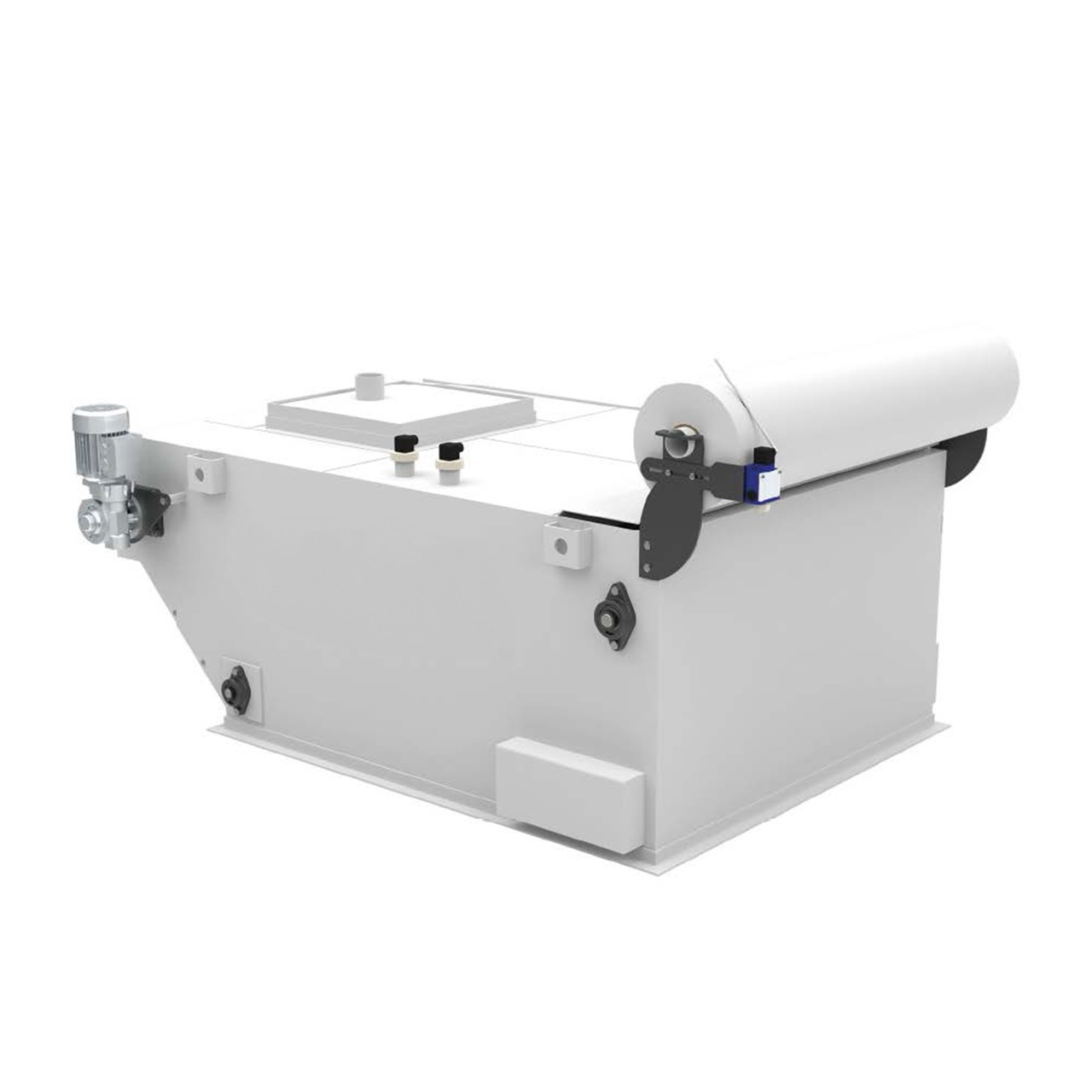
Paper bed filters remove fines and sludge from coolant, cutting oil, grinding fluid, and water-based cleaning fluids using disposable fabric on a self-advancing bed. Automatic media advance reduces operator attention and eliminates scheduled bag changes.
- 10 µm
- Fine-particle filtration with the appropriate fabric
- Automatic advance
- Fresh fabric feeds as the used media loads
- Mixed solids
- Capture ferrous and non-ferrous particles
- Up to 528 gpm
- Deep-bed capacity for water-based fluids
Compare gravity-bed and deep-bed models
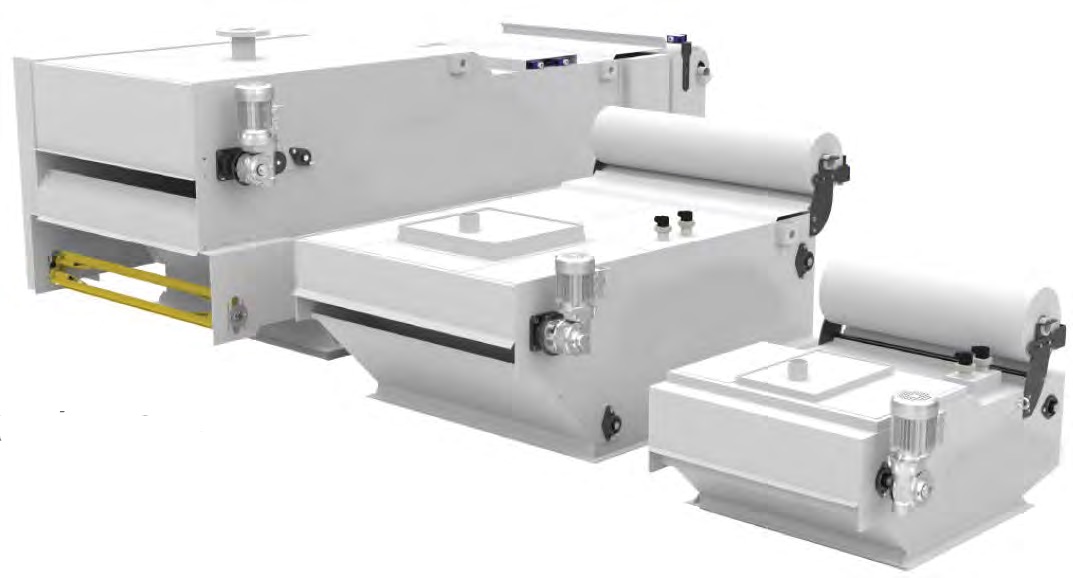
Both configurations use fabric filtration. The deep bed adds hydrostatic head for more flow from the same footprint.
Gravity bed MODEL G
A distribution trough spreads fluid across a flat fabric bed, gravity drives filtration, and a float switch controls media advance. This is the standard configuration for most grinding and machining duties.
10 models · G 50 through G 550L
13–132 GPM emulsion; oil flow is roughly half
| Model | Tank (gal) | Emulsion GPM | Oil GPM |
|---|---|---|---|
| G 50 | Confirm with quotation | 13.2 | 7.9 |
| G 100 | 79 | 26.4 | 15.8 |
| G 150 | 132 | 39.6 | 21.1 |
| G 200 | 159 | 52.8 | 26.4 |
| G 250 | 193 | 66 | 34.3 |
| G 300 | 230 | 79.2 | 42.2 |
| G 350 | 264 | 92.4 | 47.5 |
| G 400 | 303 | 105.6 | 58.1 |
| G 450L | 317 | 118.8 | 66 |
| G 550L | 369 | 132 | 79.2 |
Deep bed MODEL DF
A deeper, inclined bed develops hydrostatic head, promotes solids settling, and loads the fabric fully before advancing. The design supports higher flow within a compact footprint and dewaters sludge during discharge.
7 models · DF 150 through DF 2000
Up to 528 GPM emulsion; less fabric used per gallon
| Model | Emulsion GPM | Oil GPM | Weight (lb) |
|---|---|---|---|
| DF 150 | 42 | 21 | 264 |
| DF 250 | 68 | 34 | 330 |
| DF 400 | 106 | 53 | 551 |
| DF 600 | 159 | 79 | 661 |
| DF 1000 | 264 | 132 | 1,102 |
| DF 1500 | 396 | 198 | 1,543 |
| DF 2000 | 528 | 264 | 2,094 |
Full dimensional drawings are available with the specification package. Custom flow and capacity requirements receive an engineering review.
Max fluid viscosity 20 cSt at 40°C, both series. Trays galvanized metal, with full stainless-steel builds for corrosive fluids, pure water, and food-industry duty. Control panel and re-circulation pumps included. Talk to an engineer for dimensional drawings →
Filtration for metallic and non-metallic solids
Paper bed filters handle coolants, water-soluble fluids, water-based cleaning fluids, cutting oils, and grinding fluids with a maximum viscosity of 20 cSt at 40°C. They remove ferrous and non-ferrous metals along with organic and inorganic particulate; the fabric grade sets the rating from 10 to 60 microns and can be selected for the application.
Applications include removing metal fines and abrasive grit from grinding fluids, filtering machining and honing sludge from coolant and cutting oils, and capturing suspended particles in water-based cleaning and detergent baths.
- Metallic and non-metallic particlesFabric filtration captures ferrous and non-ferrous fines, abrasive grit, and other suspended solids.
- Fabric determines the micron ratingAvailable fabric grades provide filtration from 10 to 60 microns and can be selected for each application.
- Integrated filtration packageRecessed perforated trays, fabric roll, conveyor drive, recirculation pump, and control panel are installed on one frame.
Reduce manual filter changes and filtration downtime
Bag and cartridge housings require condition monitoring and manual element replacement. A paper bed advances fresh fabric automatically and collects spent media with the captured sludge.
- ✕Bag filter: manual element changes and housing access
- ✓Paper bed: float-triggered media advance with integrated sludge collection
Gravity filtration with automatic media advance
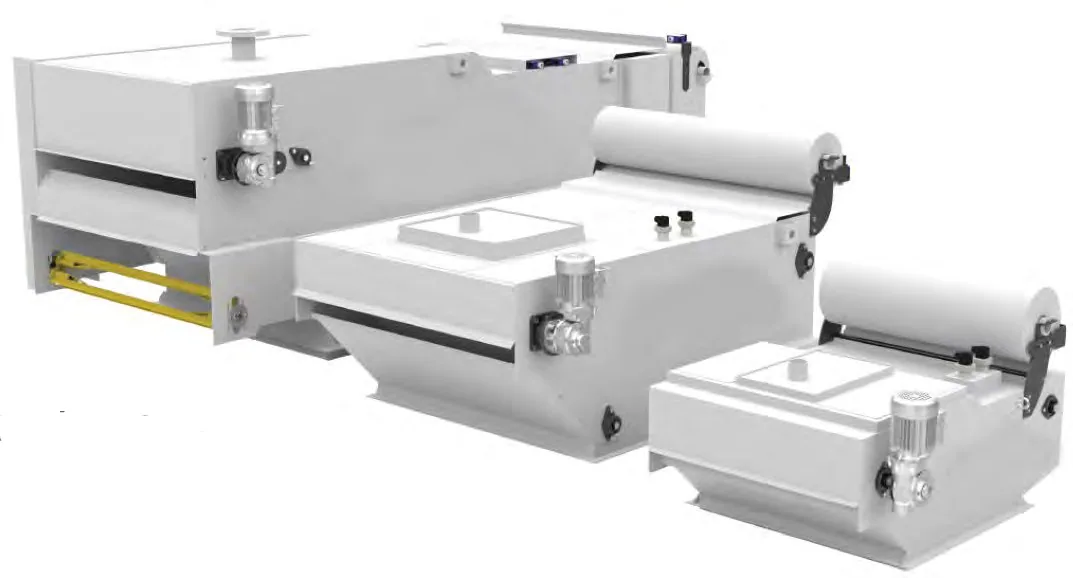
Dirty fluid passes through disposable fabric into the clean tank below. The fabric captures metallic and non-metallic particulate, which is important in grinding applications because swarf contains metal and abrasive grit that magnetic separation alone cannot remove. As the fabric loads with solids, a float switch activates the drive and advances fresh media.
- 01
Distribute the fluid
A distribution trough spreads dirty fluid evenly across the fabric below.
- 02
Capture the solids
Solids stay on top; clean fluid passes through into the tank. The fabric grade sets the micron rating.
- 03
Advance the fabric
As sludge blinds the fabric, the level rises, a float trips a switch, and the motor pulls fresh fabric forward.
- 04
Discharge the sludge
The spent section, sludge and all, rolls into the collection tank. No bag to open, no pressure vessel.
Match each process stage to the contaminant load
Paper-bed filtration captures mixed fines, grit, and sludge. Ferrous-heavy loads benefit from upstream magnetic separation, while facility-wide coolant management requires a recycling system.
The DCO Filter System combines magnetic separation with paper-bed filtration. Its upstream magnetic stage removes ferrous fines before they reach the fabric, reducing media consumption and associated operating cost. Both stages are sized together for the required flow and material mix.
- Paper bed
Mixed fines, grit, sludge
Abrasive grit, non-ferrous metal, general sludge: the fabric catches the particle regardless of what it is made of.
- Upstream separation
Heavy ferrous load
A magnet pulls ferrous fines out before they touch fabric, so the bed advances less often.
Magnetic separator → - Coolant management
Whole-shop recycling
C.R.O.S.S. adds tramp-oil removal, concentration control, bacteria-control options, and facility-wide coolant recycling.
See C.R.O.S.S. →
Product and application questions
Which filtration grade suits my process?
Available fabric grades range from 10 to 60 microns. The appropriate grade depends on the fluid, particles to be removed, and cleanliness your process requires. For machining and grinding, surface-finish requirements also guide selection.
Talk to an engineer →Is there a model for low-flow or single-machine duty?
The G 50 is the smallest listed gravity-bed model, rated at 13.2 GPM for emulsions and 7.9 GPM for oil. If the standard tank or footprint does not fit your installation, discuss the space and fluid flow you need to accommodate. An engineer can size the filter and tank together.
What drives filter-media consumption, and how is it reduced?
Fabric consumption is the primary running cost. Three levers reduce it: the deep bed loads media fully before advancing, a magnetic separator upstream removes ferrous load so the fabric lasts longer, and the correct grade avoids over-filtering.
Does a paper bed filter address coolant condition on its own?
No. A paper bed keeps fines out of the fluid; it does not remove tramp oil, control bacteria, or maintain concentration. C.R.O.S.S. can address broader shop-wide coolant management, with a paper bed added where finer particulate removal is required.
Review C.R.O.S.S. integration →Keep fines out of your process fluid
Keep cleaner fluid circulating with automatic filtration sized for your process.