
Your shop's central coolant recycling system
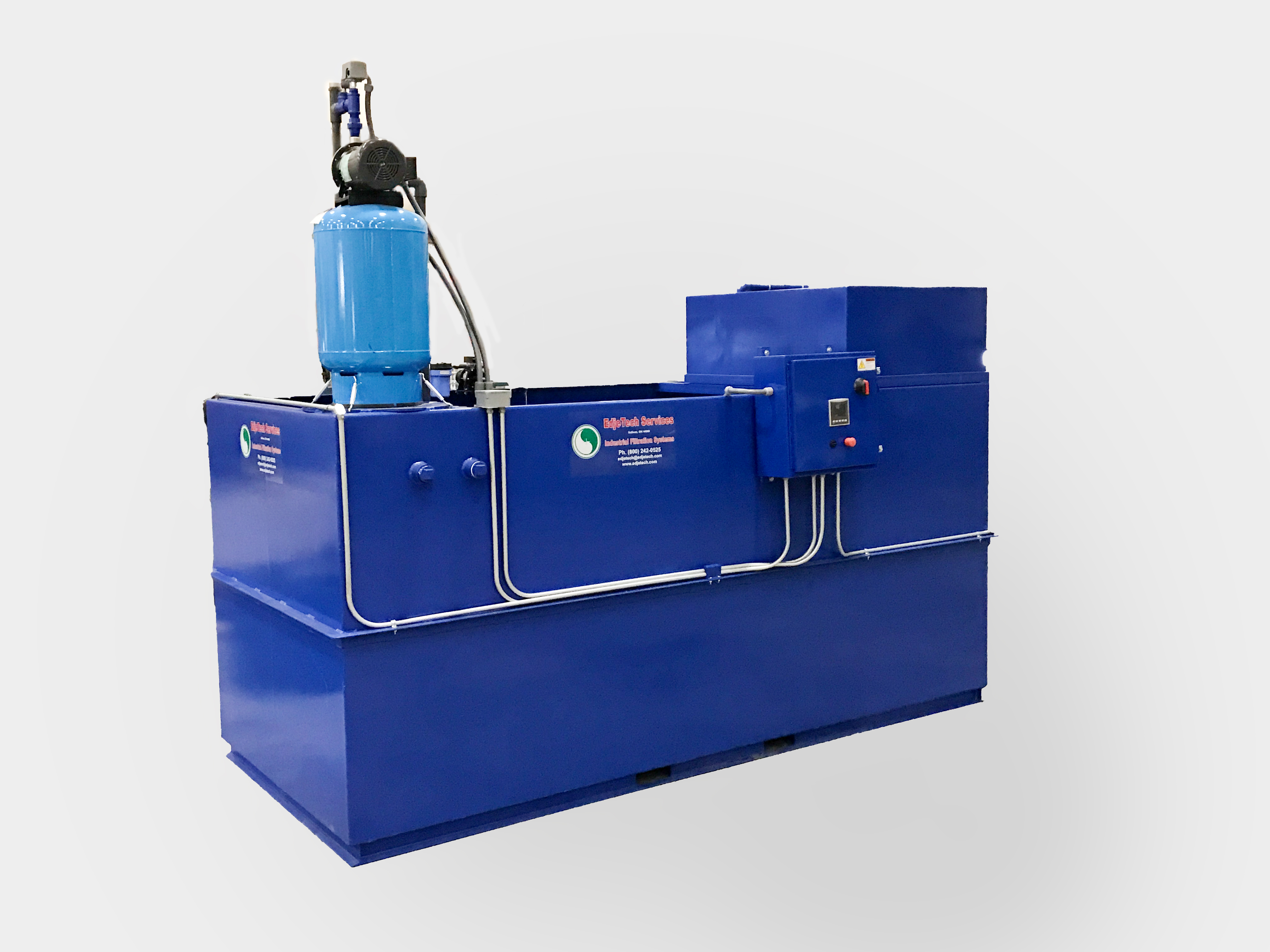
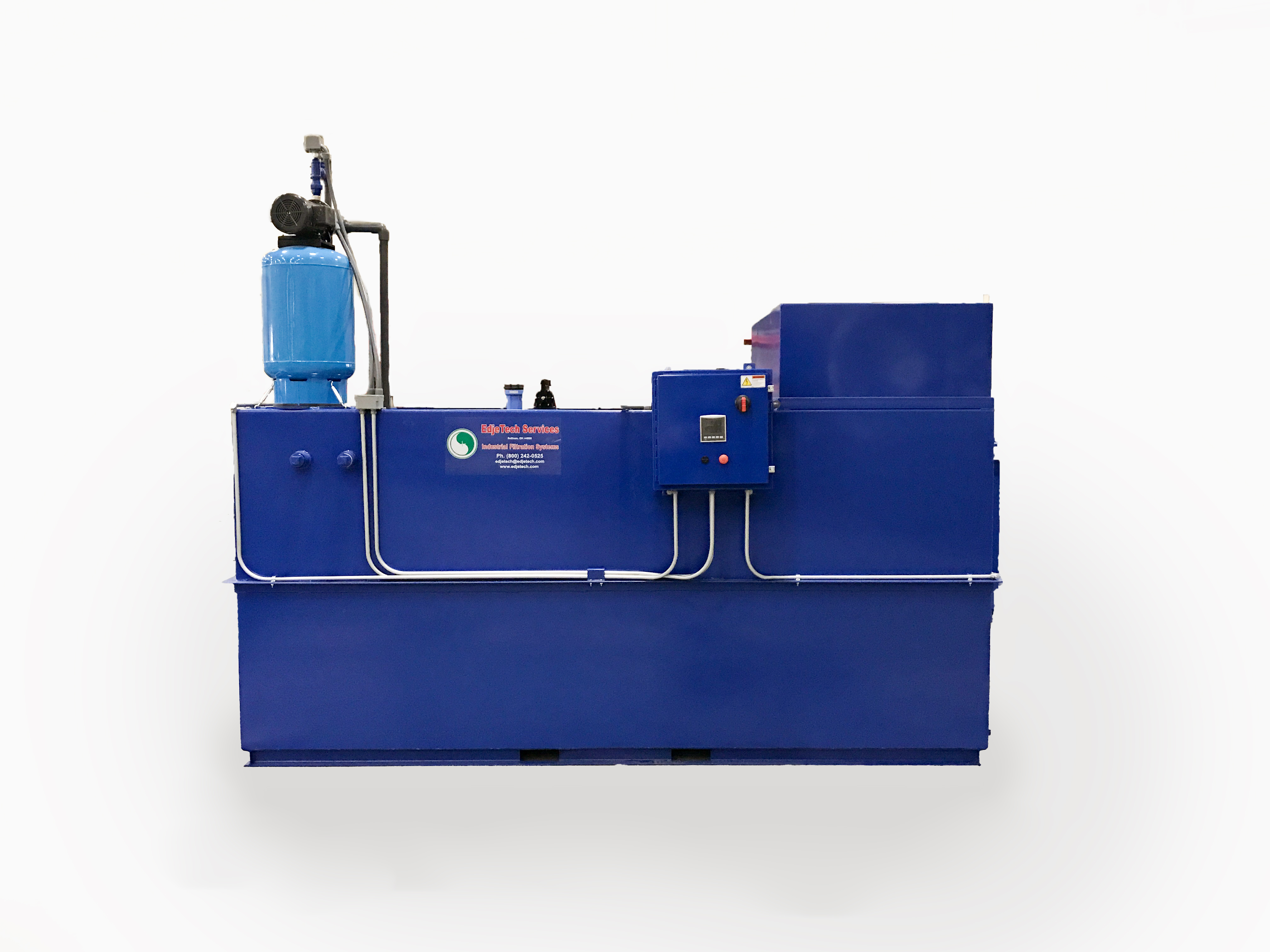
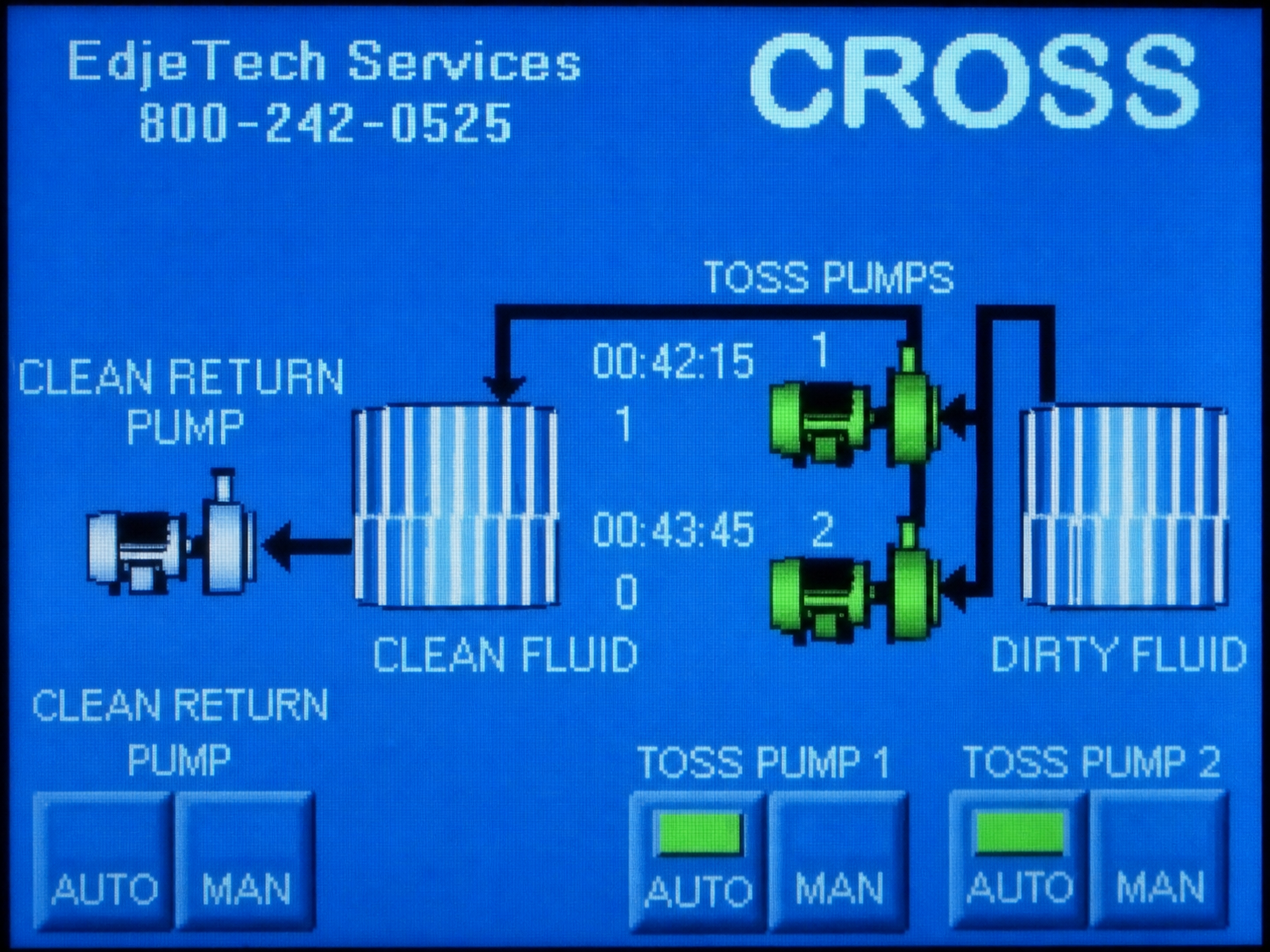
C.R.O.S.S. is an industrial coolant recycling system for machine shops with CNC, conventional, or mixed machining operations using compatible water-based coolant. It removes 99.75% of tramp oil and particulate by volume and maintains clean coolant for immediate use 24/7/365. Six models support batch, central, and hybrid configurations from 2 to 25 GPM.
- Up to 85%
- Reduction in new coolant purchases
- 99.75%
- Tramp oil and particulate removed, by volume
- 24/7/365
- Clean coolant available for immediate use
- Automatic recycling
- Continuous processing without constant operator attention
Six standard models, 2 to 25 GPM
Use portable transfer for batch recycling, add the optional Coolant Return System for piped clean-coolant distribution, or combine both in a hybrid layout. The six models below cover 120 to 1,500 gallons per hour.
Compare deployment layouts| Model | Flow (GPM) | Flow (GPH) | Dirty tank (gal) | Clean tank (gal) | Footprint L×W (in) | Tank / overall ht (in) | Phase |
|---|---|---|---|---|---|---|---|
| 250 | 2 | 120 | 130 | 120 | 60 × 42 | 36 / 39 | Single |
| 450 | 5 | 300 | 250 | 200 | 72 × 48 | 46 / 49 | Single |
| 850 | 10 | 600 | 450 | 400 | 120 × 48 | 50 / 53 | Three |
| 1200 | 15 | 900 | 600 | 600 | 132 × 60 | 54 / 57 | Three |
| 1600 | 15 | 900 | 800 | 800 | 132 × 60 | 82 / 78 | Three |
| 2200 | 25 | 1,500 | 1,100 | 1,100 | 168 × 96 | 58 / 64 | Three |
Beyond the standard six models, available configurations include integrated pre-filtration with magnetic separators or paperbed filters for heavy ferrous and fine-particulate loads, an on-site ozone generator for bacteria control, the pressurized CRS return loop for central deployment, and custom builds engineered to a specific duty.
Contact EdjeTech for custom sizing
- Operating temp
- 50 to 180°F ambient
- Construction
- Carbon steel with chemical-resistant paint; stainless steel construction can be specified; polypropylene coalescing media; piston-style proportioner
- Electrical
- Voltage configured per order; phase as listed above
- Site requirements
- Self-contained skid supplied in startup condition; requires electrical service, city water, and a tramp-oil collection container
- Factory options
- Pre-filtration, Coolant Return System (CRS), electronic refractometer, ozone generator
- Add-ons
- Magnetic separators, paperbed filters, coalescers, and skimmers for specific applications
- Applications
- CNC milling and turning, centerless and surface grinding, gear grinding, titanium, Inconel, and aluminum, automotive ICE and EV component machining, aerospace tier-2/3 work
Central, batch, or hybrid: your layout sets the configuration
Select batch, central, or hybrid coolant transfer to match the facility layout, machine count, and operating volume.
- Clean-coolant distribution
Central
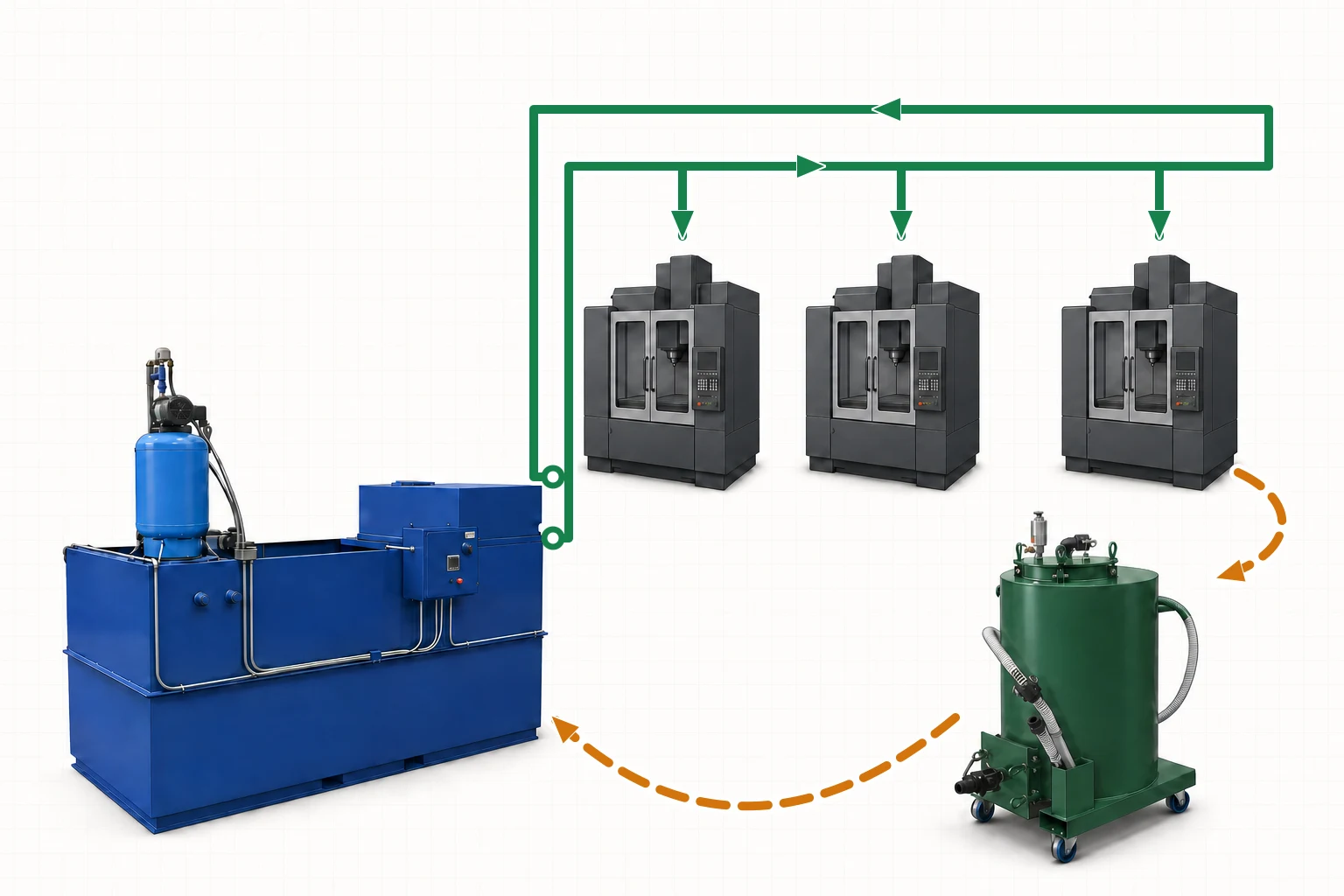
Closed clean-coolant loop with machine dropsPortable dirty-coolant collection The optional Coolant Return System (CRS) supplies clean coolant through a pressurized 35 to 40 PSI loop, with distribution points for on-demand sump fills. Dirty coolant is normally collected with a Green Machine or another compatible portable transfer device. A configured dirty-coolant return line can also be incorporated where the facility layout supports it.
Central deployment → - Portable, no loop
Batch
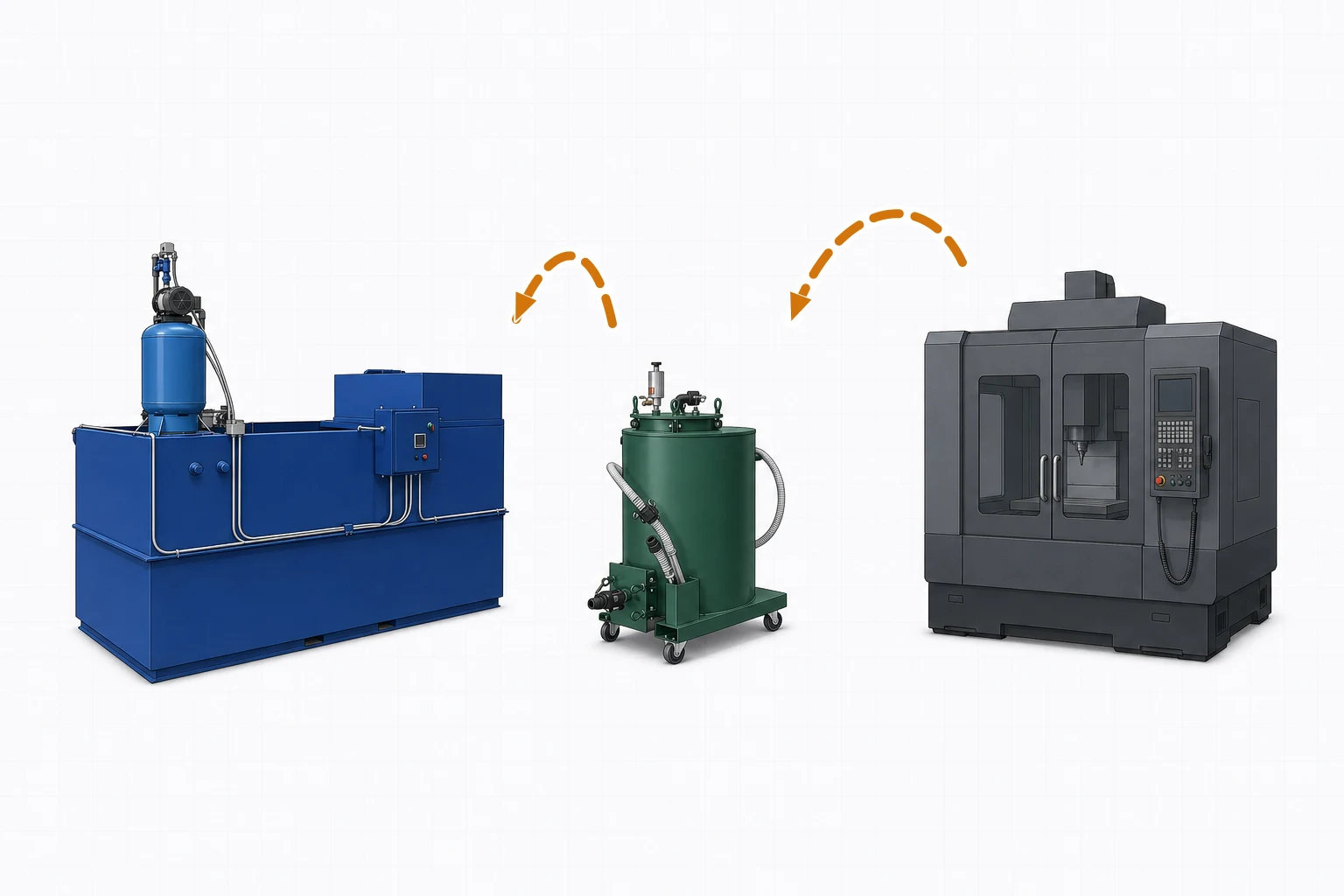
Portable dirty-coolant transfer to C.R.O.S.S.Clean coolant remains immediately available for refill. Batch configuration uses a Green Machine or another compatible portable transfer device to collect dirty coolant from individual reservoirs and deliver it to C.R.O.S.S. Central piping is not required, and the system can be implemented without a facility-wide piping network. Clean coolant remains available immediately, without waiting for the delivered batch to finish processing.
Batch deployment → - Mixed layout
Hybrid
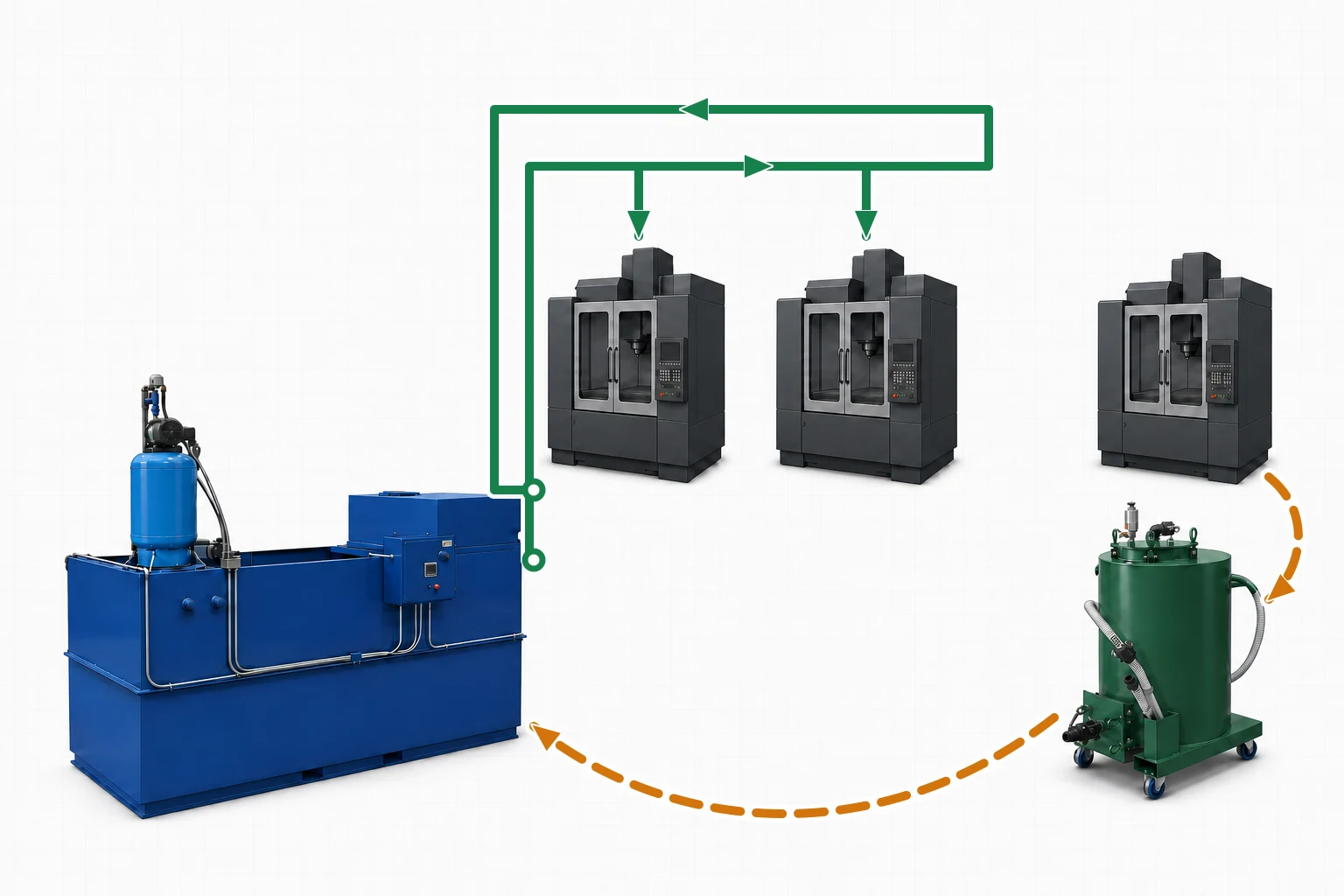
CRS loop serves the main production areaPortable transfer serves remote cells Clean-coolant distribution serves the main production area, while portable transfer serves remote or satellite cells from the same C.R.O.S.S. system. Clean coolant remains available for remote-machine refill.
Hybrid deployment →
System functions and operating results
| System function | How it works | Operating result |
|---|---|---|
| Coalescing oil/water separator | A polypropylene media pack brings dispersed and loosely emulsified tramp-oil droplets together so they rise to the surface. The separated oil drains to your holding container. | Tramp oil below 1/4 of 1% · recovered oil may be suitable for reclamation or reuse, subject to acceptance requirements |
| Continuous circulation | The clean tank overflows back into the dirty tank, so the system re-clarifies your fluid even with no new dirty coolant entering. | Clean coolant available 24/7/365 · uptime of 99% or greater |
| Coolant proportioner | Automatically mixes concentrate and water at the required concentration to replace coolant lost through evaporation, chips, and normal use. | Coolant ready for use at the correct concentration · consistent machining performance |
| Closed-loop recycling | The same fluid returns to the machines, reducing off-site disposal and replacement-coolant demand. | Up to 85% lower new-fluid purchases · up to 90% lower disposal cost |
| Bag filter & pre-filtration | Solids are caught ahead of the separator; magnetic separators and paperbed filters can be added for heavy ferrous or fine-particulate loads. | Fines kept off your pumps and tools |
| Ozone generator option | Replaces routine biocide dosing with automated bacteria control using ozone produced on site. | Controls bacteria automatically · neutralizes odors |
| Self-contained skid | Dirty tank, separator, clean tank, proportioner, and controls on one skid, shipped in startup condition. Operation is automatic. | Requires electrical service, city water, and a tramp-oil collection container · no dedicated operator |
| Fluid-management records | Removal performance, coolant use, and disposal volumes can be tracked during operation. | Supports operating reviews and environmental reporting |
One separation pass, then continuous recirculation
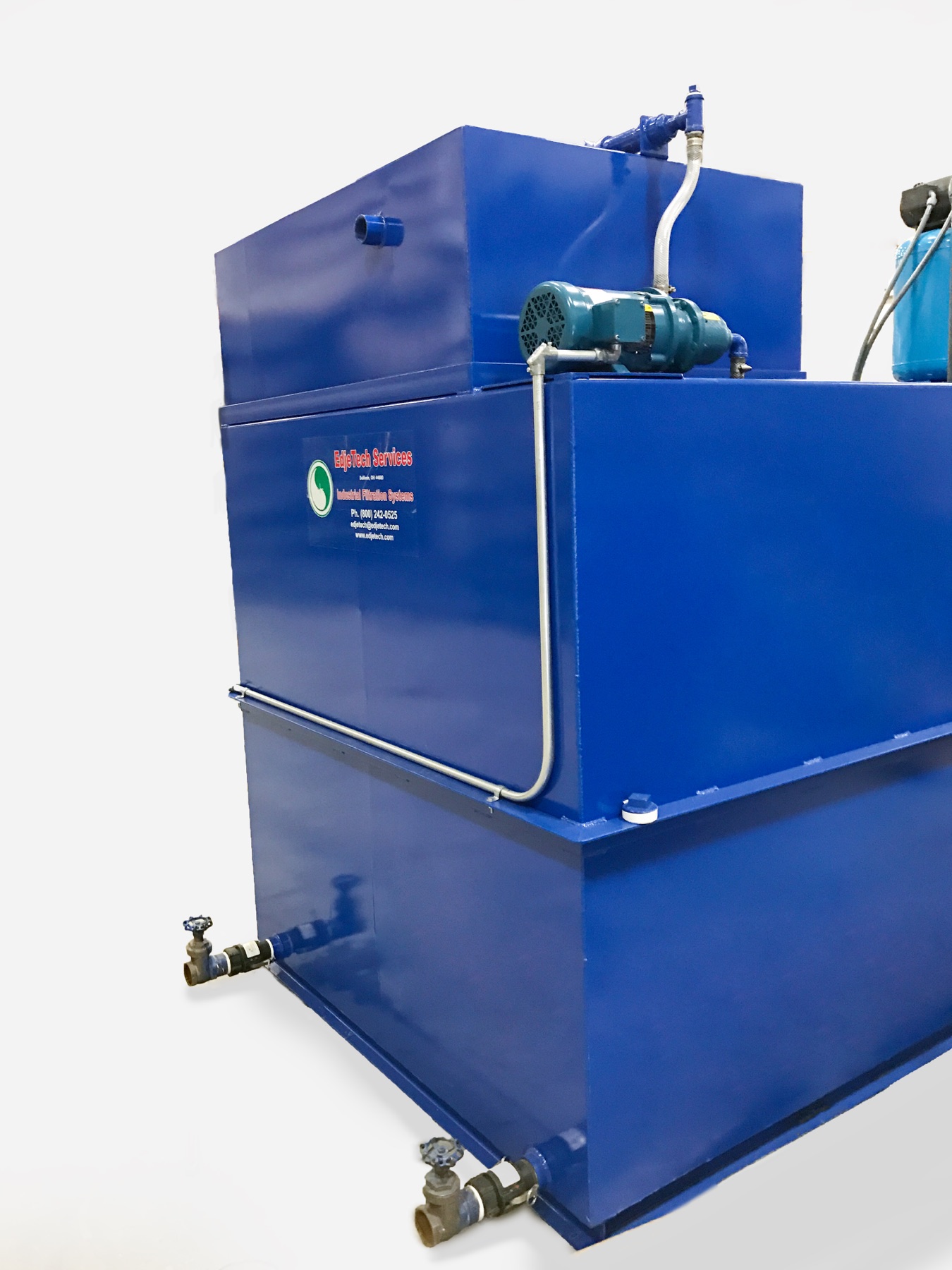
The self-contained skid integrates a dirty tank, oil/water separator, clean tank, coolant proportioner, and automatic controls.
- 01 · INTAKE
Dirty tank & skimmer
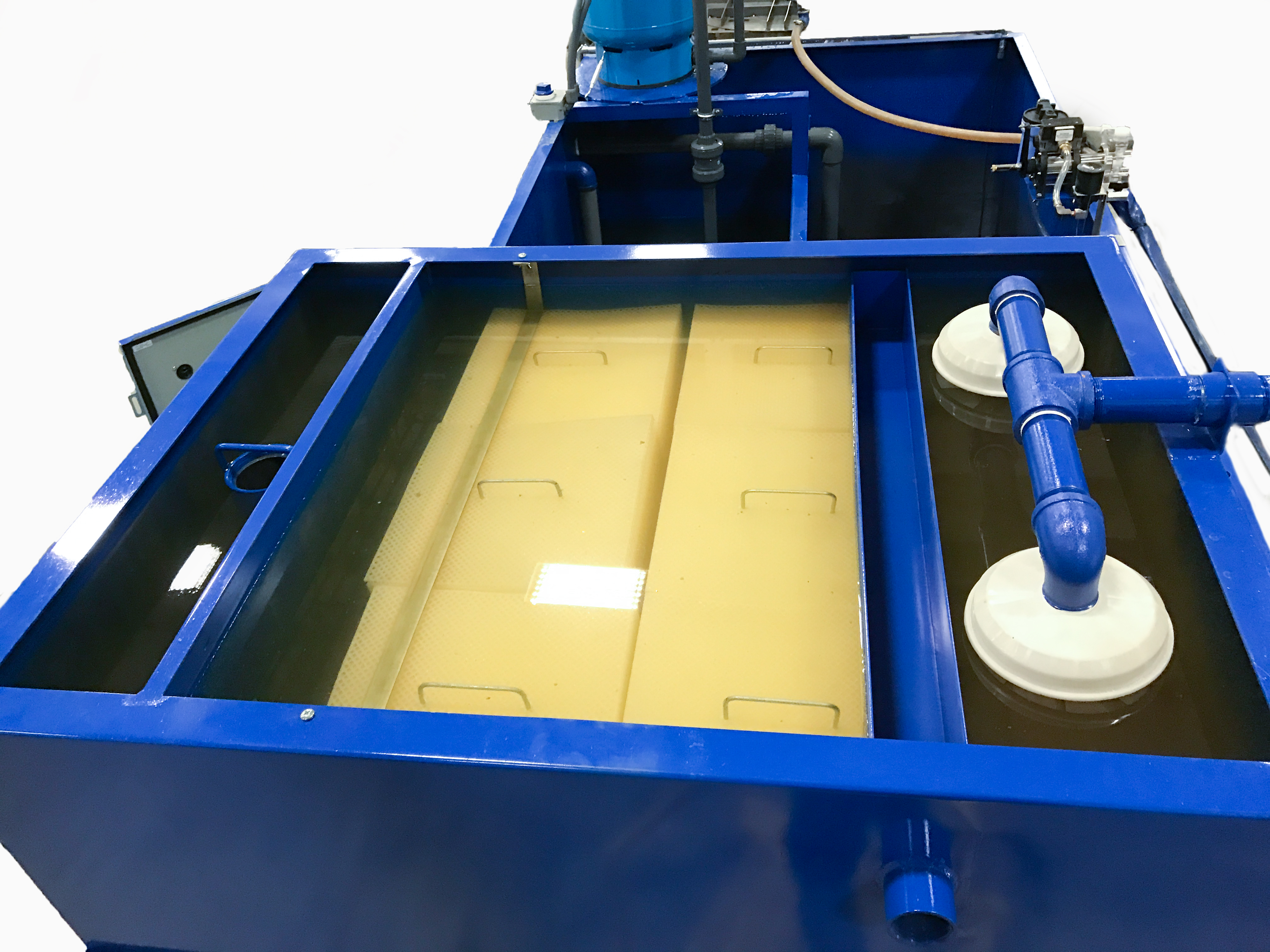
Contaminated coolant enters the dirty fluid tank. A ballast floating skimmer rides the surface; the separator supply pump pulls free-floating oils through it into the bag filter, which catches solids.
- 02 · COALESCE
Media pack
Fluid flows through a polypropylene coalescing media pack. Dispersed and loosely emulsified tramp-oil droplets merge into larger drops that rise and join the free-floating oil at the surface of the separator.
- 03 · SEPARATE
Trough & weir
The oil layer seeps into a tramp oil trough and gravity-drains to your holding container. It may be suitable for reclamation or reuse, subject to composition, waste classification, and recipient requirements. Clean fluid overflows an adjustable weir into the clean tank.
- 04 · HOLD & RETURN
Proportioner & controls
A piston-style proportioner meters fresh concentrate and water automatically, holding concentration steady with no operator mixing batches. When clean-coolant demand exceeds dirty-coolant return, the proportioner automatically mixes and adds makeup coolant at the required concentration, maintaining the clean-coolant reserve.
The clean tank overflows back into the dirty tank, so the system continuously re-clarifies the fluid even when no new dirty coolant is entering. Clean coolant remains available for immediate use 24/7/365, with system uptime of 99% or greater.
One contaminant it will not separate: chemically emulsified oil. Emulsifying-type cleaners should not be used with the system. EdjeTech confirms fluid compatibility during the application review.
99.75% tramp oil and particulate removal by volume
The following field results show coolant conditions measured during operation at a working installation.
Residual tramp oil: below 1/4 of 1% by volume.
| Measure | First reading | Held at |
|---|---|---|
| Tramp oil | 2% | nil / trace ring |
| Cream layer | 26% | 2% |
| Suspended solids | 0.05% | nil |
| Concentration | 15% | 7% · stabilized |
| pH | 8.6 | 8.5–8.9 in range |
| Aerobic bacteria | 10⁴ | held 10⁴–10⁵ |
| The remaining 2% cream layer was attributed to a way oil containing its own emulsifier. Changing the way lubricant was recommended. | ||
The ozone option: bacteria control at the source
Tramp oil and suspended solids support bacterial growth that shortens coolant life and creates persistent odors. C.R.O.S.S. removes these contaminants while the optional ozone generator provides automated bacteria control.
Ozone is produced on site and introduced into the recycled coolant to provide automated bacteria control and neutralize odors. This option replaces routine biocide dosing, with no treatment chemicals to store or mix.
For recurring coolant odor or bacteria concerns, review the coolant diagnostic →
- Power
- 115 VAC, 0.6 amps, 65 watts; plugs into a 115V outlet on the control panel
- Hardware
- Compact wall-mount with magnetic mounts, UV lamp reaction chamber, 24-hour timer, air hose with bubbler in the clean tank
- Lamp life
- 8,500 hours average
- Service design
- Air-cooled and serviceable, with no air preparation required
- Size
- 20" × 8-3/4" × 3-1/2"
- Sizing
- Per-model ozone coverage on large models confirmed by engineering at quote
Questions engineers ask before specifying
What operating profile is suited to C.R.O.S.S.?
C.R.O.S.S. is evaluated when a machine shop needs coordinated coolant recovery across multiple machines. Suitability and sizing depend on coolant volume, required processing rate, service schedule, contaminant load, facility layout, and the selected model and unit count. Batch, central, or hybrid transfer is then configured to match the operation.
Review batch configuration →How does coolant recycling differ from filtration?
Filtration removes solids. C.R.O.S.S. also separates tramp oil, maintains coolant concentration, supports bacteria control, and returns the coolant to service instead of sending it for disposal.
Will it work with our fluid?
C.R.O.S.S. is designed for water-based coolants carrying free-floating, mechanically dispersed, or loosely emulsified tramp oil and suspended solids. Chemically emulsified oil cannot be removed through oil/water separation. An EdjeTech engineer reviews fluid chemistry, separation behavior, contaminants, and operating conditions to confirm compatibility.
Request a coolant compatibility review →What operating savings can be evaluated?
Performance ranges include up to 85% lower new-coolant purchases and up to 90% lower disposal cost. Application-specific simple payback is estimated from the quoted system investment and the facility's current coolant, labor, maintenance, and disposal costs.
Estimate operating savings →What routine maintenance and support are provided?
C.R.O.S.S. operates automatically with no scheduled daily service. Routine ownership care centers on condition-based filter replacement and planned periodic inspection and cleaning. EdjeTech provides consumables, replacement-parts identification, and technical guidance for the installed system.
Review support resources →Documented C.R.O.S.S. operating value
- up to 85%
- Reduction in new
fluid purchases - up to 90%
- Reduction in
disposal cost
Closed-loop recycling can reduce new-fluid purchases by up to 85% and disposal cost by up to 90%, with 99.75% of tramp oil and particulate removed by volume.
An EdjeTech engineer confirms coolant compatibility and system configuration during the application review.
Recover the coolant you pay to replace
Recover used coolant for your machines and reduce what you spend on fresh fluid and disposal.