
Choose the right level of coolant management.
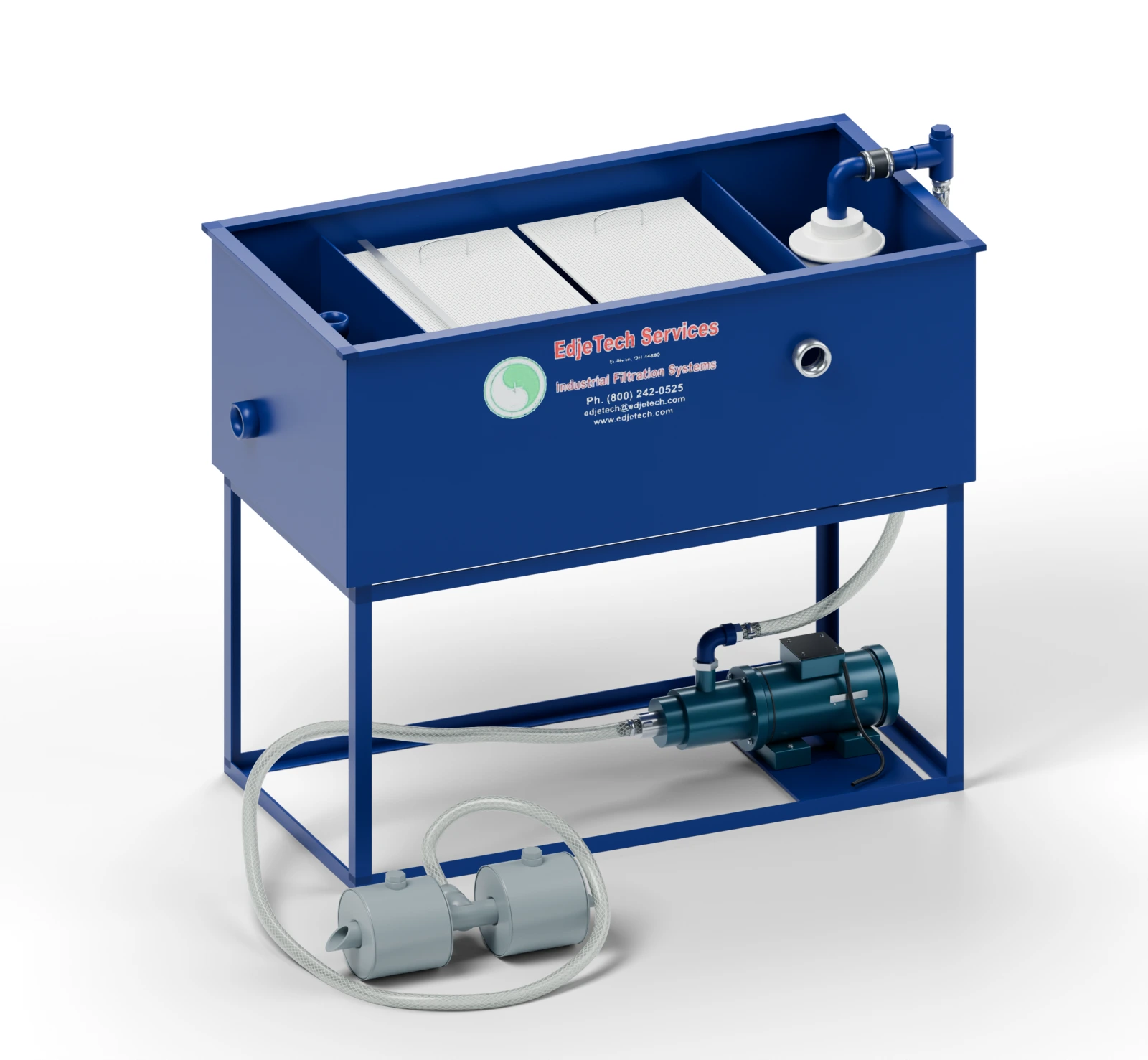
C.R.O.S.S. manages coolant recovery across multiple machines. The T.O.S.S. family removes tramp oil at individual reservoirs, with fixed and portable configurations.
Identify the appropriate approach ↓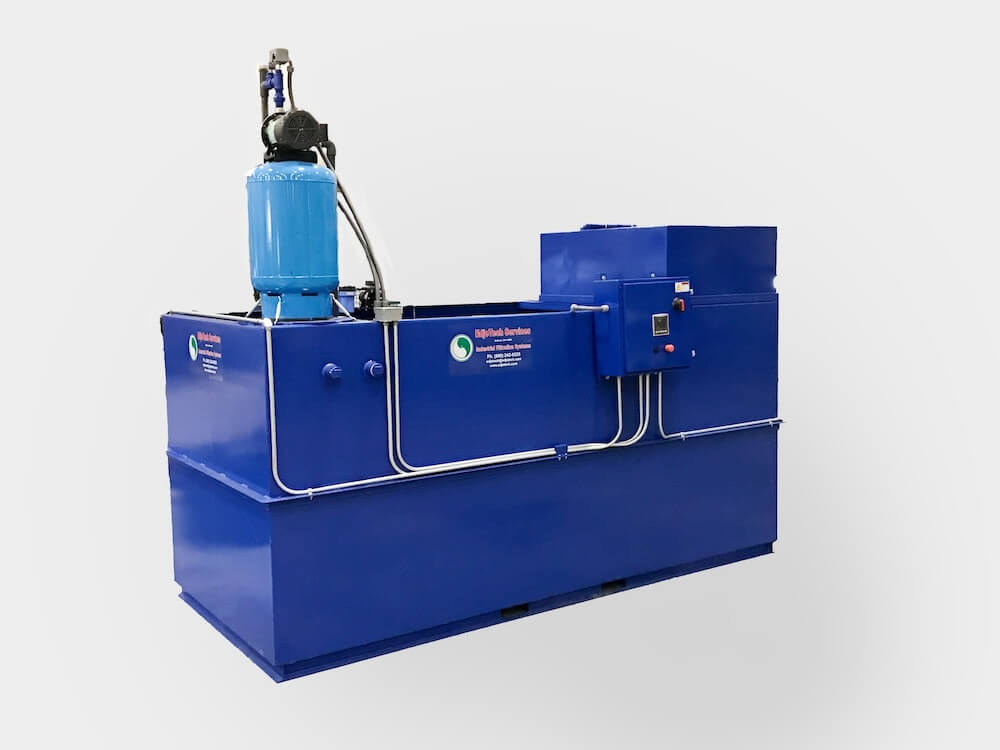
What should the equipment do?
Select the situation closest to your operation. Final sizing depends on the coolant, contaminant load, reservoir volume, processing rate, service schedule, and facility layout.
Choose by scope, location, and operating method
The first decision is whether the operation needs facility-level coolant recovery or tramp oil separation at an individual reservoir.
- 01 · Operating scope
Facility or reservoir
C.R.O.S.S. recovers coolant collected from multiple machines and maintains clean coolant for immediate use. T.O.S.S. treats coolant at an individual sump, reservoir, pit, or parts washer.
- 02 · Equipment placement
Central, dedicated, or portable
C.R.O.S.S. supports batch, central, or hybrid fluid handling. Standard T.O.S.S. models provide dedicated reservoir-level treatment. The T.O.S.S. T1 moves between individual reservoirs.
- 03 · Treatment objective
Recycling or oil separation
C.R.O.S.S. combines tramp oil and particulate removal with clean-coolant storage, concentration management, and optional bacteria control. T.O.S.S. removes free-floating, dispersed, and loosely emulsified tramp oil, captures solids through a bag filter, and returns clarified coolant to the same reservoir by gravity.
- 04 · Capacity
Application-sized flow
Flow rate alone does not determine the system. Final selection also considers coolant volume, contaminants, service schedule, reservoir count and arrangement, and facility layout.
- C.R.O.S.S.
- Six standard models from 2 to 25 GPM
- T.O.S.S. standard series
- Seven models from 2 to 50 GPM
- T.O.S.S. T1
- Portable 2 GPM configuration, 90 to 120 GPH
Operating role, placement, and capacity
Initial equipment selection depends on operating scope, equipment placement, flow range, and treatment requirements. Model specifications and compatibility requirements then define the final configuration.
| Selection factor | C.R.O.S.S. | T.O.S.S. standard | T.O.S.S. T1 |
|---|---|---|---|
| Primary function | Facility-level coolant recovery, filtration, and reuse | Autonomous tramp oil separation at a dedicated reservoir | Portable tramp oil separation moved between reservoirs |
| Equipment location | Central recycling station serving multiple machines | Installed at one sump, large reservoir, pit, or parts washer | Portable skid serving one reservoir at a time |
| Flow range | 2 to 25 GPM across six standard models | 2 to 50 GPM across seven standard models | 2 GPM, adjustable from 90 to 120 GPH |
| Fluid handling | Batch, central, or hybrid collection and clean-coolant distribution | Skims the reservoir surface and returns clarified coolant by gravity | Connects to an individual reservoir, treats it, then moves to the next |
| Rated performance | Removes 99.75% of tramp oil and particulate by volume | Holds tramp oil below 0.5% by volume and separates 99% of oil droplets 20 microns and larger on the first pass | Provides the same rated T.O.S.S. coalescing performance in the portable configuration |
| Solids handling | Bag filtration with pre-filtration options for heavier particulate loads | Bag filter supplied at 100 microns, with 1 to 200 microns available | Bag filtration in the portable separation circuit |
| Operation | Automatic recycling with clean coolant available for immediate use 24/7/365 | Autonomous operation without continuous operator oversight | Air-powered treatment completed reservoir by reservoir |
| Best fit | Machine shops evaluating coolant recovery across multiple machines | A dedicated reservoir requiring ongoing tramp oil control | Several individual reservoirs that can share one portable separator |
One manages the facility. The other treats the reservoir.
C.R.O.S.S. coolant recovery
Dirty coolant is collected from machine reservoirs and processed at the C.R.O.S.S. station. The system maintains a reserve of clean coolant for immediate use.
- Batch: portable equipment collects and transfers dirty coolant.
- Central: clean coolant is distributed through the optional Coolant Return System.
- Hybrid: central distribution serves the main area while portable transfer serves remote cells.
T.O.S.S. reservoir treatment
A floating skimmer collects oil-rich fluid from the surface and below it, a bag filter captures solids, and coalescing media separates free-floating, mechanically dispersed, and loosely emulsified tramp oil before clarified coolant returns to the reservoir by gravity. This additional separation step matters when surface-only equipment leaves oil in circulation.
- Standard series: dedicated treatment from 2 to 50 GPM.
- T1: portable 2 GPM treatment moved between reservoirs.
- Compatibility: intended for water-based fluids with separable tramp oil.
Questions to resolve before requesting a quote
Is T.O.S.S. T1 a separate product family?
No. T1 is the compact, portable 2 GPM configuration within the T.O.S.S. family. Standard T.O.S.S. models provide dedicated reservoir treatment from 2 to 50 GPM.
Does machine count alone determine whether C.R.O.S.S. fits?
No. C.R.O.S.S. is evaluated when a machine shop needs coordinated coolant recovery across multiple machines. Final sizing depends on coolant volume, required processing rate, service schedule, contaminant load, selected model and unit count, and facility layout.
Can C.R.O.S.S. and T.O.S.S. be considered for the same facility?
C.R.O.S.S. manages facility-level coolant recovery, while T.O.S.S. treats coolant at an individual reservoir. Some facilities use both where operating areas have different requirements.
How should tramp oil be managed across multiple reservoirs?
Use the portable T1 when independent sumps or reservoirs can share one separator on a planned schedule. Use a standard T.O.S.S. model where continuous oil loading or the required treatment rate calls for dedicated separation. EdjeTech reviews reservoir count and volume, fluid chemistry, contaminant loading, and operating requirements before recommending the configuration.
What fluid information is needed?
Provide the coolant type, reservoir volume, contaminants, operating temperature, current service schedule, and whether the tramp oil separates in a standing sample. Chemically emulsified oil cannot be removed through coalescing separation.
Review the applicable equipment
- 2 TO 25 GPM
C.R.O.S.S.
Facility-level coolant recoveryReview standard models, batch, central, and hybrid configurations, performance, options, compatibility, and the application information required for system sizing.
View C.R.O.S.S. → - 2 TO 50 GPM
T.O.S.S.
Dedicated reservoir treatmentReview the standard separator series, skimmer selection, operating process, rated performance, options, and specifications.
View T.O.S.S. → - PORTABLE · 2 GPM
T.O.S.S. T1
Portable reservoir treatmentReview the six T1 configurations, compact dimensions, air requirements, skimmer choices, and individual-reservoir applications.
View T.O.S.S. T1 →
Treat individual sumps or recover coolant across the shop?
Keep coolant in service longer with oil removal at individual reservoirs or recycling across your shop.